March 12, 2020

3 Reasons Why You Should Read To All The Boys I've Loved Before


To All the Boys I’ve Loved Before (TATBILB) by Jenny Han, is a New York Times bestselling novel about sixteen year old Lara Jean Covey, who writes love letters to all the boys she’s ever liked. When these letters get leaked and sent to the boys themselves, Lara Jean’s life turns to chaos as she ends up entwined in a fake relationship contract with the star school lacrosse player, Peter Kavinsky. The book focuses on the relationship between Lara Jean and Peter. They must pretend to be in a relationship in order for Peter to give Lara Jean her letter back and save her from the embarrassment of him leaking it around the school, and for Peter to make his ex-girlfriend jealous. However, as time goes on, they begin to question their “fake” feelings, and wonder if they’re actually real. With that, here are 3 reasons why you should read To All the Boys I’ve Loved Before:
  1. It’s relatable. 
We typically find it hard to resonate with teenagers portrayed in books, because most of the time they have magical powers or go to a wizard school. However, TATBILB portrays teenagers in a realistic light. An example of this is how Lara Jean is particularly school focused, and is aware of college preparations. This contrasts to how not many books have teenagers being focused on school, and the plot reigns unrealistic if the book does not contain fictional aspects. 
  1. It has many deeper meanings. 
TATBILB displays a lot of themes that are applicable to our everyday lives. One theme I observed that stuck out to me was the theme of maturity. In the beginning of the book, Lara Jean attaches her feelings to the letters she wrote to the boys she liked in the past. She describes love as playful and innocent. When her letters get leaked, she is set free from the confinement of her feelings to her past crushes. This enables Lara Jean to begin her relationship with Peter Kavinsky, and towards the end of the book, readers observe a significant tone change. A matured Lara Jean now sets herself free of the confinement of emotion, and the tone of the book is wiser rather than her naive introduction. The theme of maturity is able to be applied to our lives by the means of acknowledging emotions and feelings rather than pushing them away, or locking them up in a box through a series of letters to past crushes, in Lara Jean’s case. 
  1. Love is inescapable
Regardless of your views on love, it is something we all have for individuals in our lives, like our family members. We are all capable of loving and being loved, and this is an important topic TATBILB explores. Lara Jean writes her letters to her past crushes as a goodbye to the love she once had for them. She realizes love cannot be faked, and is a strong compelling feeling that doesn’t always have to entail sadness. She changes her definition of love as her tone grows more mature and wise, which is both an interesting and realistic parallel between Lara Jean at the beginning of the book versus Lara Jean towards the end.
-Zoya Ahmad

March 6, 2020

Why Some Books Really Can be a Bad Call

https://www.amazon.com/Bad-Call-Stephen-Wallenfels/dp/1484768132

Why Some Books Really Can be a Bad Call


       Bad Call by Stephen Wallenfels is a young adult novel about four teenagers going on a backpacking trip in Yosemite. Colin, Grahame, Ceo and Rhody are all on the tennis team at their school, and they had made a bet over a game of poker to go on a camping trip together one weekend. However, Rhody dropped out, so, to the other boys’ surprise, Ceo invites a seemingly random girl who he met at a summer camp named Ellie to come along with them in place of Rhody. After pulling a lot of tricks and sneaking behind their school’s and parents’ backs, they finally leave for Yosemite. 
I started reading this book and found it mediocre. I kept reading, and the more I read, the less I enjoyed it. Despite having little interest in the story, I decided to keep reading a bit further into the book before I quit. It is quite rare that I do not read through an entire book, but this one I really just had some issues with, so I will explain why I eventually just dropped it. 
The first reason that I wasn’t enjoying Bad Call was that I honestly just found it boring and slow. Many books are slower paced but may still be interesting or have an important point to make, but this just seemed too drawn out without much interesting content. One example that displays this is that Wallenfels takes nearly 80 pages, or 17 chapters just for them to arrive in the park which is approximately a quarter of the book. This section is focused just on them packing up and making plans to go. Some of the book is dedicated to showing how Ellie is getting ready, and her thoughts on the trip, which I thought was nice to have two perspectives, but this too is drawn out. Reading about about past tennis tournaments, what kind of bug spray they Grahame will pack, and who will carry the food, for a quarter of the book doesn’t seem to have much significance to the overall plot. One of the things I look for first in a good book is its ability to hold my attention and keep me waiting for more, which I have to say this book simply failed at. I didn’t see any way that I could really benefit from this book, so I stopped reading. 
The next aspect of Bad Call which I found annoying was how unoriginal it was, and how many cliché aspects it had. The first character that displays very cliché behaviors is Ellie. She doesn’t ever wear makeup, wears cargo pants, is very passionate about animals and the environment, and an avid feminist almost to the point of having a strong bias against men. While none of these things are actually bad, and some of them I would even argue are positive traits to see in books today, all of these combined and the general way the author describes her definitely fits the stereotype of the super progressive, nature-loving girl. When explaining to Colin some things she doesn’t like she says, “Cigarette butts, They take ten months to ten years to biodegrade and are a fire hazard. Why isn’t that considered littering? […] number one on my all-time love-to-hate list: elephant poachers. Don’t get me started on them,” (Wallenfels 133). These characteristics fit perfectly into the stereotype. The other character was Ceo and he fir the “playboy” stereotype pretty clearly. In the book he is described as “picking up girls” left and right, constantly in a relationship with some new conventionally attractive girl and being somewhat of a womanizer. While how cliché something is can be hard to concretely describe and show through specific quotes, I definitely got the feeling that the author just copy and pasted his characters leaving them with no depth. Watching as these characters were described, I couldn’t help cringing at the lack of originality.
Overall, I don’t think this is inherently a terrible book, I just didn’t find it worth my time and believe there are many books out there that are actually written well. I wanted to show that it is ok to be critical of the literature we read and that sometimes books really aren’t worth finishing, which I could demonstrate through Bad Call. 

13(-10) Reasons Why (You MUST Read "The Murder at the Vicarage" by Agatha Christie)

Warning!! You will not be able to stop reading this book!
Caution is advised.

Agatha Christie’s The Murder at the Vicarage is a fascinating book. Just like the other books involving the sleuth Miss Marple, this book is a work of art. Let me introduce you to Miss Marple. Miss Marple is an elderly woman who lives in the small town of St. Mary Mead. Because of her living to an old age, and being in a small village, Miss Marple has been able to examine human nature and uses this fact to her advantage when sleuthing. Anyway, enough about the main character, let’s talk about the book. These are the 3 reasons why you should read The Murder at the Vicarage.

1. Murder mysteries are the best type of books
This statement is completely opinion based, but I will explain why in my opinion this is an objective truth. I enjoy the suspense that is involved in this book and that is involved in most murder mysteries. Murder mysteries are also my favorite because the reader can attempt to solve the mystery along with the sleuth.
2. Agatha Christie is hands down the best murder mystery author
Many people will try to argue with this by saying that I forgot about Sir Arthur Conan Doyle’s Sherlock Holmes, but indeed, as I just proved, I did not. Of course, I have not read all of the murder mystery novels on the planet so this is a bit of an exageration but from my experience Agatha Christie is the best. Although I do love Sherlock Holmes, it is too unrealistic for me. The Miss Marple books are very realistic and this allows the reader to have a better chance at solving the mystery. Agatha Christie also writes in a style that makes the novel very suspenseful which makes the experience even more entertaining.
3. The Murder at the Vicarage is a page-turner
This book in particular is very intriguing because the murder occurs in such a holy place as a vicarage. It seems so odd and yet it happens. Every page there is new evidence and information that may be useful or just a red herring. You can never know who is telling the truth which is what keeps you on your toes and always thinking about this case.

Who will solve the mystery first: you or Miss Marple? Good luck!

February 16, 2020

Girlhood in the Borderlands


Girlhood in the Borderlands 
Girlhood in the Borderlands is a book about teenage girls from Mexico caught in the crossroads of migration. The author, Lilia Soto, focuses on their development as adolescents dealing with family members who have migrated to the US. About sixty girls are interviewed in Girlhood in the Borderlands. Perspectives on America and migration vary among the interviewees. As people who live in America, it is important for us to acknowledge the perspectives of those who have gone through the immigration process to live in our country and their family members.
  Girlhood in the Borderlands is nonfiction. Even without fantastical elements, there are still prevalent themes that occur throughout the book to which readers can easily pick up on. One of the most important themes I observed while reading Girlhood in the Borderlands, was the idea of hard work. The girls interviewed all had to step up to replace the roles of their fathers and help their mothers, despite some of the patriarchal norms common in their society. Many had to quit school, some as young as grade 7, in order to help their mothers in work settings, or at home with domestic duties. Financial problems, said by the majority of the girls, had occurred as a result of their fathers leaving for America in hopes of finding better work opportunities. 
Another theme I found to be interesting while reading Girlhood in the Borderlands, was education. Throughout all of the interviews with the girls, the majority said schooling and seeking higher education were the least of their priorities. In fact, it was rare to have read an interview with a girl planning to go to college. Education was seen as a privilege, and with so many families left without a father figure, they needed as many relatives to pitch in with financial support as soon as they could-even if it meant the sudden withdrawal of schooling. Girls as young as fourteen who were interviewed said they became pregnant and had to drop out of school. This stood out to me, as I had never seen the extent of the privilege of education that many people take for granted every day (myself included). 

Girlhood in the Borderlands is a massive reality check. As American citizens, we often go long periods of time without acknowledging our privilege of living where we do, and how many of us never had to immigrate. Lilia Soto’s interviews with the girls provide readers with a sense of charm, ambition, and inspiration, as they share their stories. I would recommend Girlhood in the Borderlands to anyone wanting a good, non-fiction read. 
-Zoya A.

February 14, 2020

What Makes Up Who We Are?


Emotional Intelligence 2.0
     Emotional Intelligence 2.0 talks about a vital characteristic that everyone should have, emotional intelligence (if it wasn't obvious already). Emotional intelligence represents "your ability to recognize and understand emotions in yourself and others, and your ability to use this awareness to manage your behavior and relationships" (16, Bradberry). In other words, the communication between the emotional and logical part of your brain would be emotional intelligence. At first, to many people, emotional intelligence may seem to be a trivial thing. However, it has been proven that for every EQ (Emotional Quotient, a measurement of emotional intelligence) point someone has above average, they earn about $1,300 more per year. The book emphasizes that a human is made up of three parts. Their personality, their IQ (intelligence quotient), and their EQ.
    On the title page, there are two images on the bottom left and right which both represent the same concept, a linkage between our emotions and our logical thinking. According to the book, our primary senses send signals to our brain through our spinal cord, then through the limbic system ("the place where emotions are produced"), before reaching the place where rational, logical thinking takes place. In other words, our minds are wired to think emotionally first, before we think logically. The picture on the bottom left corner shows a picture of the heart inside a human's skull, signifying that our emotions control us more than we think. On the bottom right corner shows a picture of a brain and heart linking together, representing good communication between our logical and emotional side, which results in high emotional intelligence.
     The background of the title picture shows the three attributes that make up a human, personality, EQ, and IQ. The IQ of an individual represents not how good someone is at doing a certain subject but describes their ability to learn. The book described IQ to be "fixed from birth. You don't get smarter by learning new facts or information" (18, Bradberry). The book also mentions personality, "the stable 'style' that defines each of us" (18, Bradberry). In other words, your personality is the culmination of all your preferences, such as your inclination to introversion or extroversion. Though, just like IQ, your personality stays constant throughout your life. However, the one attribute you can change about your self is your EQ. EQ is a flexible skill, while IQ and personality do not change.  In the end, "IQ, EQ, and personality added together are the best way to get a picture of the whole person". On the recreated title page, I showed that even though these three traits make up who we are, they do not overlap much since they cover their own unique space.


February 10, 2020

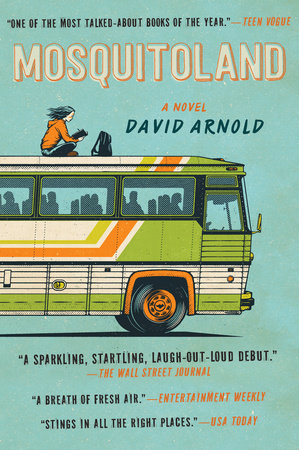
4 Relevant Topics in Mosquitoland


Mosquitoland by David Arnold
3 Relevant Topics in Mosquitoland

Mosquitoland  by David Arnold follows Mary Iris Malone, or Mim for short on her adventure through the US. She originally lived in Ohio, until after a sudden divorce, she was forced to move to Mississippi with her dad and new wife. This compelling novel published in 2016 may be written for teens, but it focuses on some issues and topics that are very prevalent in our world today and can teach readers quite a bit.
I would recommend this book especially to teens, but also to some adults as well, as it can give an insight into a younger perspective. This could be especially appealing to people who have experienced some of these things, and to those who have not, it may expose them to new ideas.

1. Grief and Death
In Mosquitoland,  Mim is forced to deal with the sudden and surprising death of a friend, a hard experience which practically everyone deals with at some point. After a horrible accident, she says “I am empty […] All that’s left is a fierce hunger for flight […] Choking back a flood of tears, I wonder, What in the world am I going to do without you?” (Arnold 60-61). This passage shows the raw feelings that come with a big loss, and throughout the book continues to show her grieving. Later she describes “Pushing back the Arlene [friend] shaped knot in [her] throat,” when doing something that reminds her of the friend.
Because loss is such a human experience, I think the feelings and horror that surround it should be normalized so that people feel that their feelings are valid. Many people may feel as though the extent to which they are grieving is wrong, but the truth is, it can be a very traumatizing experience. This book does an excellent job at discussing these feelings.

2. Mental Illness
There are several characters in this book who experience mental illness. Mim herself was diagnosed with Schizophrenia at a young age. She struggles with mild hallucinations but on top of that it creates a lot of tension within her family. Her father, who’s own sister hung herself, is afraid for Mim and pressures her to take various medications which are making her sick and unhappy. She says, “Dad bought into the notion that there was One Right Way to solve a problem. Or rather, to solve my problem. […] Peer pressure is one thing, but when your dad’s the pusher, it’s something else entirely,” (Arnold 171). This quote clearly shows the toxicity of his actions. Her mother on the other hand is more supportive, listening to what she needs, and taking her to a therapist who was really helping her. Mim says of the therapist, “Dr. Makundi as it turned out was more than a decent doctor. He was a decent man. […] He let me talk when I needed to talk, and talked when I needed to listen,” (Arnold 170). This clearly describes a much more respectful and beneficial relationship, one that, had her father not cut off, could have continued to help her.
These starkly different opinions, each person sure they are right, cause a lot of issues and lead to bad relationships between the family. Mim then feels misunderstood, which is a common feeling that people experience with mental illnesses. By reading about her experiences, those who struggle with this might feel more understood, and even learn more about how to cope. Also, for those caring with family members going through this, people can learn how to listen better, and really try to do what is best for their loved one.  

3. Sexual Assault
Unfortunately today, many people are sexually harassed every day, and Mosquitoland gives insight into that experience in an eye-opening way. Mim throughout the book is followed by a man, who pays obsessive attention to her. The two characters have complicated relationship, until eventually Mim’s suspicions about his evil intentions are confirmed. During the intense scene in which the man assaults her, she says “Predator versus Prey, passed down from a thousand generations of women who, like me, feared the inevitable. We’d seen the footage of the hyena and the gazelle, and it always ended the same,” (Arnold 83). In this quote she describes the traumatic experience in the moment, but throughout the rest of the book we really see some of the damage this can do. She expresses guilt and shame for not being able to stop him, as well as inability to revisit the place of the incident without panicking. Because this is sadly so common in today’s society, I think it is important for people to read about. For those who have experienced sexual assault it may offer comfort, and for those who have not – insight. 

February 7, 2020

Speeding through the Motorcycle Diaries

Ernesto Che Guevara: The Motorcycle Diaries
Ernesto Che Guevara was a famous Marxist revolutionary. He was born on June 14th 1928 in Argentina. In 1959, he aided Fidel Castro in their revolution in Cuba over the dictator Fulgencio Batista. He wanted to spread revolution all around the world, especially in developing countries. He went to Bolivia and tried to train the revolutionaries there in guerilla combat. He was eventually captured by the Bolivian army, with aid from the U.S., and executed on October 9th, 1967. He was buried in a secret place but in 1997 they found his place of burial and reburied him in Cuba. (bbc.com).
The book, or diary, of Ernesto Che Guevara does not mostly talk about his revolution and how he became a revolutionary. Instead, it talks about how he and his friend, Alberto Granado, planned to travel from Argentina to North America on “La Poderosa,” a Norton 500 Motorcycle, the name meaning “the powerful one.” This bike was Alberto’s and they thought of this plan on vacation, drinking maté (the Argentine national drink, a herb tea). In December of 1951, when Che Guevara was 23, they set off on this trip. They knew it would be difficult but they did not know how difficult. This book is a diary written by Ernesto Che Guevara on his journeys through South America on La Poderosa. Che Guevara and his friend Alberto were studying to be doctors. That is why their family was so surprised when they said they would leave for North America.
This book is not the greatest read for fiction lovers. However, it is a good book for non-fiction lovers. It is not the most well written book because some things sound funny in English. This is because it is 1) a diary and Che Guevara was not an author, and 2) translated. Because of the translation some things are weirdly worded but the meaning is easily understood. Reading about this great journey and all the struggles, but also the successes and the people that helped them along the way, made me see what it was really like to be completely and totally free. It was intriguing to read about two friends that one day decide to travel across the continent and how they improvised along the way. Of course, this type of trip requires relying on others to give you rides and food and a place to sleep, but it really shows you how hospitable some places in South America, and Che Guevara stressed Chile, can be. 
In my view, this book turned out to be a pretty good read for a non-fiction book. I do not usually enjoy non-fiction books but this one was an exception. I think that if you like non-fiction books you should definitely read this and even if you do not like non-fiction books, give it a try. It is also not a long book making it a relatively quick read. 
BBC. "Che Guevara (1928 - 1967)." BBC, edited by BBC, 2014, www.bbc.co.uk/

     history/historic_figures/guevara_che.shtml. Accessed 7 Feb. 2020.